
Experience-driven short-term rentals are reshaping the Midwest STR market, allowing owners to justify higher nightly rates, improve occupancy, and stand out in increasingly competitive regions like Ohio, Indiana, and Kentucky. By investing strategically in amenities and resort-style features, STR owners can transform ordinary properties into destination experiences that attract higher-value guests and generate more durable revenue.
12 Things STR Owners Should Understand About Experience-Driven Rentals
- Experience-driven rentals compete on amenities, not just location
- Luxury and amenity-rich STR demand is growing faster than budget tiers
- Midwest markets are seeing outsized booking growth without coastal pricing
- Hot tubs consistently deliver the strongest ROI across regions
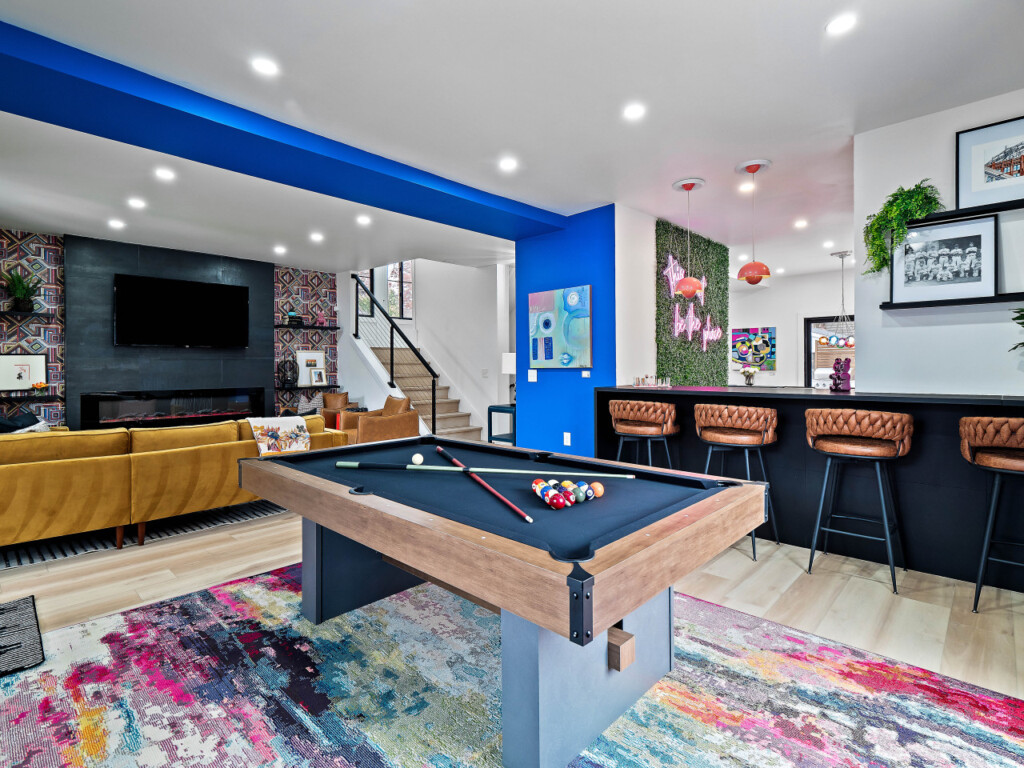
- Game rooms increase group bookings and longer stays
- Pools justify premium pricing but require high revenue thresholds
- Larger properties benefit disproportionately from experience upgrades
- Amenity investments raise both ADR and off-season occupancy
- Urban and rural markets reward different amenity strategies
- Pet-friendly positioning expands demand with minimal capital
- Experience-driven properties create competitive moats once established
- Poorly matched upgrades can raise costs without improving performance
Understanding Resort-Style Properties & Amenity-Rich Vacation Homes in Ohio, Kentucky, and Indiana
The short-term rental landscape has fundamentally shifted. While basic, clean properties with good locations once commanded premium rates, today’s travelers increasingly seek something more: an experience that extends beyond accommodation into entertainment, luxury, and memorable moments they can’t recreate at home.
These properties go by several names; Experience-Driven Rentals, Resort-Style STRs, and Amenity-Rich properties. They all seek to transform a simple overnight stay into a destination experience through carefully curated features that justify premium pricing and drive consistent bookings.
What Are Experience-Driven Rentals?
Experience-Driven Rentals represent properties where the amenities and overall experience become as significant a draw as the location itself. They’re thoughtfully designed spaces where guests can spend an entire vacation without feeling they’ve missed anything by staying “home.”
The market data tells a compelling story. The luxury vacation rental segment reached $26.5 billion in 2024 and is projected to grow at 9.3% annually through 2034. Unique accommodation listings grew 123% between 2020 and 2024, signaling a fundamental shift in what travelers seek. Market research shows 21% of travelers now prioritize unique, hands-on experiences when selecting accommodations.
For existing STR owners in Ohio, Kentucky, and Indiana, this creates both opportunity and competitive pressure. Cleveland saw 20.9% year-over-year booking growth in 2025, while Indianapolis exploded with 33% growth. These aren’t coastal resort towns; they’re Midwest markets where experience-driven properties are capturing outsized demand.
Market Trends Driving Experience-Driven Demand
Several converging trends have accelerated the rise of amenity-rich vacation rentals. Remote work normalization means travelers book longer stays and expect properties that support both productivity and recreation. A property with just beds and Wi-Fi no longer competes effectively against one offering a home gym, game room, and outdoor entertainment space.
Economic factors also play a role. While 2025 brought concerns about inflation, demand for vacation rentals continued growing with shifting patterns. Budget-tier properties saw average daily rates decline by 0.33%, while luxury-tier properties experienced 5.23% ADR growth. Travelers are increasingly willing to pay premium rates for premium experiences.
Properties with six or more bedrooms (often those with space for extensive amenities) saw the fastest booking growth at 12.61% year-over-year. Three-bedroom properties with strong amenity packages followed at 7.48% growth. Meanwhile, smaller properties without distinctive features struggled to maintain occupancy.
Perhaps most telling, three out of four STR operators reported higher guest ratings in summer 2025 compared to 2024. This improvement came from operators investing in property improvements and enhanced amenities that drive guest satisfaction.
Investment Framework: Understanding Cost Ranges
The investment spectrum spans from modest additions to complete property transformations. Understanding where your property fits is critical for strategic decision-making.
Entry-Level Enhancement: $3,000-$15,000
This range covers single-amenity additions that meaningfully impact bookings without requiring major capital. Quality hot tub installation typically runs $5,000-$10,000, with annual maintenance around $570. Game room basics (pool table, foosball, dart board, classic arcade game) can be assembled for $3,000-$8,000. Fire pit installations range from $1,000-$5,000.
Hot tubs consistently command 20-25% ADR premiums in most markets. For properties averaging 150 bookings annually, that translates to $7,500-$15,000 in additional annual revenue from an $8,000 investment.
Mid-Tier Transformation: $15,000-$50,000
This level allows multiple amenity additions or one significant feature. Above-ground pools with decking cost $15,000-$30,000. Dedicated game rooms with high-end equipment run $10,000-$20,000. Themed room renovations cost $8,000-$15,000 per room. Home theater installations range from $15,000-$35,000. Outdoor entertainment areas span $20,000-$50,000.
Properties in this range typically support 15-30% ADR increases while improving occupancy rates by 3-7%. ROI timelines extend to 2-4 years in most markets.
High-Tier Resort Experience: $50,000-$150,000+
This level creates true destination properties. In-ground pools with integrated spas start at $50,000 and can exceed $100,000. Indoor pools range from $75,000-$150,000+. Complete game room buildouts with bowling lanes, golf simulators, VR systems, and full bars run $40,000-$80,000.
Properties at this level compete in entirely different booking tiers, often commanding $400-$800+ nightly rates in Midwest markets. They require properties capable of generating $75,000+ in annual revenue to justify the capital outlay.
Geographic Considerations: What Works Where
Urban Market Dynamics
Cleveland’s 20.9% booking growth and Indianapolis’s 33% increase weren’t driven by properties mimicking coastal beach houses. Cleveland properties near the Rock & Roll Hall of Fame, Cleveland Clinic, and sports venues benefit from amenities supporting business travelers: home offices with quality connectivity, fitness equipment, and entertainment options.
Cincinnati’s position near corporate headquarters and universities creates demand for properties accommodating visiting executives and families touring colleges. Game rooms and entertainment spaces support group bookings.
Akron, with its median home price of $153,000 and solid 5.97% cap rate, exemplifies the Midwest value proposition. Properties can add experience-driven amenities at lower total investment levels than coastal markets while still commanding meaningful ADR premiums.
Indianapolis’s success stems partly from event-driven demand; the Indy 500, NCAA tournaments, Gen Con. These types of events reward properties offering group entertainment.
Rural and Resort Markets
Hocking Hills in Ohio represents the crown jewel of Midwest rural STR markets. Logan properties near state parks consistently outperform by offering what guests can’t get in urban settings: hot tubs with forest views, fire pits under starlit skies, game rooms for rainy days.
Kentucky’s bourbon tourism corridor (Frankfort, Bardstown, Louisville) creates unique positioning opportunities. Properties benefit from upscale finishes, quality outdoor entertaining spaces for group tastings, and entertainment options for accompanying family members.
Lake markets across all three states (Lake Erie properties in Huron and Sandusky, Kentucky Lake) see strong performance from properties offering water-adjacent amenities. Pools become less critical when you’re steps from a lake, but covered outdoor spaces, fire pits, and game rooms create differentiation.
Strategic Considerations: When Experience-Driven Investments Make Sense
Strong Candidate Properties
Properties in markets with high baseline occupancy but room for ADR growth represent ideal candidates. If you’re consistently booked at 70-80% occupancy but rates feel constrained by competition, amenity additions can break through that ceiling.
Large properties in family-destination markets benefit disproportionately. A six-bedroom home near Cedar Point in Sandusky competes most effectively by becoming a destination itself rather than just lodging near an attraction.
Properties in shoulder-season markets gain substantial value from amenities that extend bookability. Hocking Hills properties with hot tubs and indoor entertainment book through winter when outdoor activities slow.
Poor Candidate Properties
Properties in saturated luxury markets where resort-style amenities have become table stakes offer limited upside. If every comparable property already features hot tubs and game rooms, adding the same won’t create differentiation; it just raises your cost structure.
Small properties in budget-conscious markets rarely generate sufficient ROI. A two-bedroom property in a market where ADR tops out at $150 likely can’t support $30,000 in amenity investments.
Properties in markets with weak baseline demand shouldn’t add amenities as a rescue strategy. If your property struggles to achieve 40% occupancy, a hot tub won’t solve the fundamental demand issue.
Amenity Categories and Typical ROI Patterns
- Hot Tubs: The Consistent Performer
Hot tubs represent the most reliable amenity investment across virtually all markets. Properties with hot tubs command 20-25% ADR premiums, with average ADR increases of 24%, occupancy improvements of 7%, and overall RevPAR lifts of 33%.
Installation costs of $5,000-$10,000 combined with $500 plus annual maintenance create manageable expense profiles. Hot tubs work particularly well in Ohio, Kentucky, and Indiana because they provide winter appeal when guests can’t use outdoor spaces comfortably for five or six months annually.
- Swimming Pools: High Impact, High Investment
Pools drive an 18.5% ADR boost and 5% occupancy increase, with overall RevPAR improvements of 24%. However, investment requirements of $50,000-$100,000+ mean pools only make sense for properties capable of absorbing that capital while maintaining positive cash flow.
Pool ROI varies dramatically by market. Indiana and southern Kentucky properties benefit more than northern Ohio locations where weather limits pool seasons. Expect $1,200-$3,000 annually for maintenance, plus insurance premium increases.
- Game Rooms: Steady Demand Driver
Well-equipped game rooms see booking increases of 2.5-3.5%, with investment ranging from $3,000 for basic setups to $40,000+ for comprehensive installations. Game rooms’ real value emerges in multi-day bookings and group rentals where on-site entertainment heavily influences property selection.
Equipment versatility matters significantly. Properties with diverse options (pool tables, arcade machines, foosball, darts, board games) appeal to broader age ranges than single-focus installations. The $10,000-$15,000 mid-range investment typically outperforms either basic or ultra-high-end approaches.
- Home Theaters: Premium Experience Feature
Dedicated home theaters with quality projection systems, acoustic treatments, and comfortable seating create memorable experiences. Investment ranges of $15,000-$35,000 position these as mid-to-high-tier amenities that work particularly well in rural markets where properties serve as destination bases.
- Themed Experiences: Differentiation Through Design
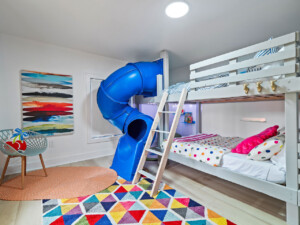
Themed rooms (Harry Potter bedrooms, Star Wars game rooms, Disney princess suites) create highly shareable experiences that drive social media exposure. Investment costs of $8,000-$15,000 per room create meaningful design impacts.
Properties work best when targeting families with children or groups celebrating specific occasions. The risk involves narrowing your potential guest pool, which multiple themed rooms targeting different interests can mitigate.
- Pet-Friendly Positioning: Overlooked Revenue Driver
Pet-friendly properties command $17.41 higher ADR on average and see 5.4% stronger demand growth. With 45% of U.S. households owning dogs, pet-friendly positioning immediately expands addressable market size.
Implementation costs remain minimal; primarily additional cleaning protocols and durable finishes. Pet fees of $50-$150 per stay provide additional revenue that often covers incremental costs while improving occupancy.
- Outdoor Entertainment Spaces: Extending Living Areas
Fire pits, outdoor kitchens, covered patios, and integrated entertainment spaces extend usable square footage. Investment ranges from $5,000 for quality fire pits to $50,000+ for comprehensive outdoor living areas.
These amenities resonate strongly in Midwest markets where outdoor living culture remains strong but weather necessitates covered spaces. Columbus suburbs and Cincinnati properties with covered entertaining areas command premiums by enabling comfortable outdoor use through shoulder seasons.
The Pros: Why Experience-Driven Positioning Works
- Premium Pricing Justification
Well-executed amenity packages enable ADR increases of 25-50% or more. Properties with hot tubs command documented 20-25% premiums, pools add another 15-20%, and game rooms contribute 10-15%. Combined thoughtfully, these can double your pricing power.
A Columbus property that might command $175 nightly as basic accommodation can justify $300-$400+ rates with strong amenity packages. That $125-$225 per night difference translates to $18,750-$33,750 additional annual revenue at 150 bookings.
- Occupancy Rate Improvements
Experience-driven properties consistently achieve higher occupancy, particularly through shoulder seasons. When outdoor activities slow in November or March, properties with hot tubs, game rooms, and indoor entertainment maintain “bookability” while basic properties sit vacant.
Higher occupancy combined with higher ADR produces RevPAR improvements that often exceed 30-50%. Properties generating $30,000 annually as basic accommodation can reach $45,000-$60,000 with strong amenity packages.
- Competitive Moat Creation
Once established, experience-driven properties create barriers to entry. Competitors can’t easily replicate your $50,000 amenity package without similar investment. This protection grows stronger as markets mature and new regulations limit property additions.
- Guest Quality and Satisfaction
Experience-driven properties attract guests willing to pay premium rates. These guests typically treat properties more carefully, generate fewer maintenance issues, and produce better reviews. Higher guest satisfaction drives repeat bookings and referrals; properties that create memorable experiences see repeat booking rates 2-3x higher than basic accommodation.
- Extended Booking Windows
Unique properties command longer advance booking windows. Guests planning special occasions book experience-driven properties months in advance, creating predictable revenue streams. This advance booking pattern enables better revenue management and reduces last-minute discounting pressure.
The Cons: Understanding the Downside
- Significant Capital Requirements
Creating meaningful experience-driven positioning typically requires $25,000-$100,000+ in capital investment. For owners operating on thin margins or with limited access to capital, these requirements can prove prohibitive. The capital intensity increases when market conditions force multiple property upgrades simultaneously.
- Ongoing Maintenance Expenses
Hot tubs require regular chemical balancing and filter changes. Pools demand even more attention. Game equipment breaks and needs replacement. Home theaters need technology updates. A property with hot tub ($570 annually), pool ($2,400 annually), game room equipment ($1,000-$1,500 annually), and advanced technology ($800-$1,200 annually) might face $5,000-$6,000 in annual amenity maintenance.
- Liability and Insurance Implications
Amenities create liability exposure requiring enhanced insurance coverage and higher premiums. Hot tubs, pools, game equipment, and outdoor fire features all present risks. These concerns extend beyond insurance costs to operational complexity requiring clear safety protocols, proper signage, and guest education.
- Market Saturation Risk
As experience-driven positioning gains popularity, competitive advantage erodes. Markets that currently reward resort-style amenities may reach saturation where such features become expected rather than differentiating. This shifts amenities from competitive advantages to operational requirements, raising costs without corresponding revenue benefits.
Louisville’s STR market exemplifies this risk. Early adopters of hot tubs and game rooms commanded significant premiums. As more properties added similar amenities, the premium compressed.
- Extended ROI Timelines
Unlike property acquisitions that generate immediate cash flow, amenity investments often require 2-5 years to recover capital. Properties generating modest cash flow may struggle to absorb extended payback periods. If your property produces $8,000 annual profit, a $40,000 amenity investment requires five years of complete profit redirection to break even.
- Increased Operational Complexity
Managing experience-driven properties requires more sophisticated operations. Amenity maintenance, guest education, damage protocols, and insurance management all demand attention. Professional management can address complexity but reduces net returns through proportionally higher management costs.
Moving Forward
Experience-driven rentals represent more than a trend; they reflect fundamental shifts in traveler expectations and competitive dynamics. For existing STR owners in Ohio, Kentucky, and Indiana, the choice isn’t whether to acknowledge this shift but how to respond strategically.
The opportunity differs by market, property type, and competitive positioning. Urban properties in growing markets like Cleveland, Indianapolis, and Columbus face different strategic questions than rural destination properties in Hocking Hills or Kentucky bourbon country. Understanding these distinctions guides smart investment decisions that create value rather than simply raising costs.
The investment ranges (from $3,000 entry-level additions to $150,000+ complete transformations) mean approaches exist for owners at every financial position. The key lies in matching investment level to property potential and market opportunity.
The Midwest STR market rewards owners who thoughtfully create experiences that justify premium positioning. The question isn’t whether to invest in your properties; it’s whether to invest strategically now while opportunity exists, or reactively later when market forces demand it.